Future Travel Overlap Apps: Droozi, avec, Pangea, and LetsOverlap Compared
Droozi, avec, Pangea, and LetsOverlap all document ways to share upcoming travel and notice when paths cross. Their differences are in how trips enter the system, who can see them, and what happens around the overlap.
Alternatives And Comparisons
A source-backed comparison of four apps that surface future travel overlap, organized around trip input, matching, audience, scope, and public pricing.
The common category: future travel overlap
Each product in this comparison lets people represent upcoming travel and use place-and-date context to reconnect. That distinguishes this category from a shared calendar that starts with free time and from an invitation tool that starts with an existing event.
The products are not interchangeable. Calendar ingestion, network model, audience controls, community discovery, and adjacent planning tools change which workflow feels natural.
Sources: Droozi features, avec official site, Pangea official site, LetsOverlap Google Play listing
Droozi: selected future plans that can become events
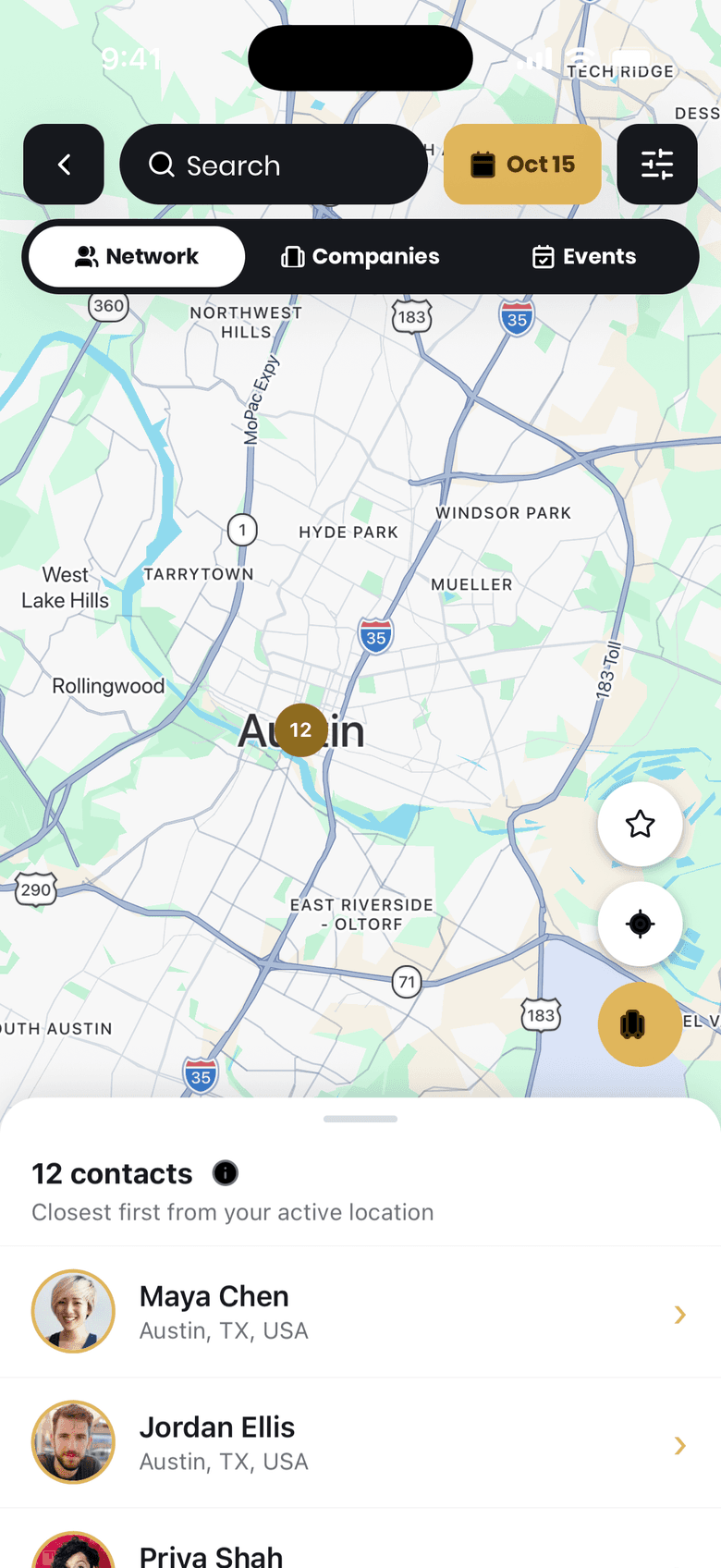
Droozi documents future locations for a place and date range, plan-level audiences, overlap with trusted contacts, and an event workflow after people decide to gather.
Its public positioning is about sharing a useful future signal rather than a continuous current-location feed.
Sources: Droozi features
avec: network-by-city with calendar-assisted trips
avec says trips can sync automatically from a calendar or be added manually before they are confirmed. It organizes a network by city and documents path-crossing alerts, contact imports, audience groups called Orbits, and scheduling around trips.
That makes the calendar and imported professional or personal network central inputs to the documented experience.
Sources: avec official site
Pangea: overlap inside a broader travel community
Pangea documents confirmed trips, tentative plans, and dream destinations, plus discovery of people going to the same place before arrival. Its official site also emphasizes recommendations, group travel, direct messages, shared trip chats, and travel-community discovery.
The overlap signal sits inside a broader social-travel product rather than being the only documented job.
Sources: Pangea official site
LetsOverlap: trip maps, feelers, and automatic detection
LetsOverlap's store listings describe single- and multi-destination trips, an interactive map, date-and-destination overlap alerts, calendar detection for travel entries, and tentative feeler trips.
The same listing describes trip visibility for friends, groups, or only the person who created the trip.
Sources: LetsOverlap Google Play listing
Pricing snapshot, not a permanent promise
Droozi listed its current core planning features as free. avec stated that it was free on iOS and Android. Pangea's current stores described it as free to download and use without establishing an exact paid-tier or in-app-purchase structure. LetsOverlap's stores listed a free download, while the reviewed official sources did not show a separate tier table.
Those statements were checked August 25, 2026. Store terms and product pricing can change, so verify the linked sources before deciding.
Sources: Droozi pricing, avec official site, Pangea App Store listing, LetsOverlap App Store listing
Side-by-side comparison
| Decision point | Droozi | avec | Pangea | LetsOverlap |
|---|---|---|---|---|
| Core planning signal | A future location combines a planned place, dates, and an audience. Source | Trips and city-based network context show when known paths cross. Source | Confirmed, tentative, or dream trips connect travelers around destinations. Source | Trips appear on a map and match when destinations and dates align. Source |
| Trip input documented | Create a future location for a place and date range. Source | Sync trips from a calendar or add one manually. Source | Add confirmed trips, tentative plans, or dream destinations. Source | Add trips or use calendar detection for flights, hotels, and vacations. Source |
| Audience and network model | Choose the audience for each future plan. Source | Organize contacts into Orbits and choose who sees trips. Source | Connect with friends and other travelers around shared destinations. Source | Set visibility to friends, groups, or only you. Source |
| Adjacent tools | Events and RSVPs can follow a discovered overlap. Source | City views, contact imports, trip scheduling, and gatherings are documented. Source | Recommendations, messages, trip groups, and community discovery are documented. Source | Feeler trips, reactions, groups, and notifications are documented. Source |
| Pricing as of August 25, 2026 | Core planning features listed as free. Source | Official site stated free on iOS and Android. Source | Current stores described it as free to download and use; exact paid-tier or in-app-purchase structure was not verified. Source | App stores listed a free download; no separate public tier table was found in reviewed sources. Source |
| Strongest when | A trusted network needs a direct future city-and-date signal that can become an event. Source | Calendar-assisted travel and an imported network-by-city are central to the workflow. Source | Travel overlap belongs alongside community discovery, recommendations, and group trips. Source | A trip map, calendar detection, feeler trips, and groups should live together. Source |
| Not ideal when | The event already exists and organizer operations are the only remaining job. Source | The group wants an event-only invitation without travel or network context. Source | A small group only needs a focused event page rather than a broader travel community. Source | The missing input is shared free time rather than travel overlap. Source |
Methodology
- We checked every linked source on August 25, 2026 and compare only capabilities described by those official sources.
- The decision axis is the first job to solve: direct future city-and-date overlap, shared availability, or coordination after an event already exists.
- An omitted feature means the reviewed source did not document it; it does not prove the product lacks it. Pricing is a dated public snapshot.
- Sources must be reviewed again within 90 days because product scope, store availability, and pricing can change.
Primary sources
- Droozi features (checked )
- Droozi pricing (checked )
- avec official site (checked )
- avec App Store listing (checked )
- avec Google Play listing (checked )
- avec developer privacy policy (checked )
- Pangea official site (checked )
- Pangea App Store listing (checked )
- Pangea Google Play listing (checked )
- Pangea developer privacy policy (checked )
- LetsOverlap official site (checked )
- LetsOverlap App Store listing (checked )
- LetsOverlap Google Play listing (checked )
Create your first future location
Download Droozi, add where you will be later, choose who can see it, and turn future overlap into a real plan.
Use cases
Explore the matching planning workflow
Move from this guide into product pages for work travel, conference networking, local meetups, and remote coordination.
Pricing
See what is free today
Confirm that current core planning features are free before deciding whether to install the app.
Events
Browse live event pages
Give readers a direct path from planning advice into public events and RSVP-ready destination pages.